
Restaking and EigenLayer: Rewards and Risks Explained

Discover how restaking works on EigenLayer. We break down the rewards, security mechanisms, and the potential risks of this innovative Ethereum protocol.
Understanding Restaking: The Next Evolution of Ethereum
Restaking and EigenLayer have become the most discussed topics in the Ethereum ecosystem. As the network transitions to Proof of Stake, restaking emerges as a way to maximize capital efficiency while securing additional services. At its core, restaking allows users to take their already staked Ethereum (stETH or other Liquid Staking Tokens) and stake them again across different decentralized applications (dApps), often called Actively Validated Services (AVS). By doing so, users earn additional yields on top of their base staking rewards.
How EigenLayer Works
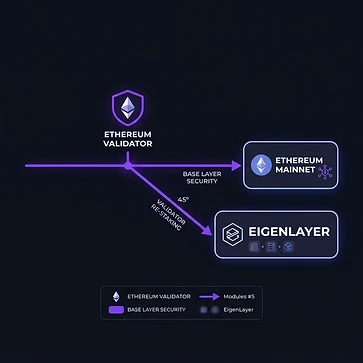
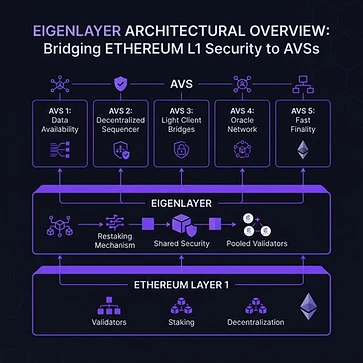
EigenLayer functions as a middleware layer built on top of the Ethereum blockchain. It acts as a marketplace where developers can rent the 'pooled security' of Ethereum stakers. Instead of building a new network from scratch, developers can tap into the massive economic security already provided by thousands of Ethereum validators. When you deposit your liquid staking tokens into EigenLayer smart contracts, you are essentially delegating your assets to secure these secondary protocols.
The Mechanism of Shared Security
- Liquid Staking Token (LST) deposits.
- Native restaking via Beacon Chain withdrawal credentials.
- Slashing conditions applied to the restaked assets.
- Multi-protocol yield accumulation.

The Rewards: Why Restake?
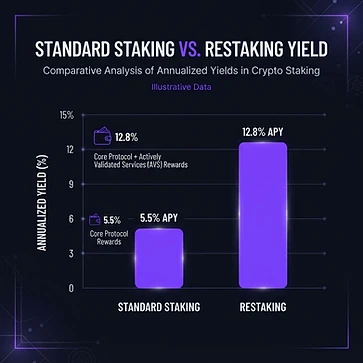
The primary incentive for participating in restaking is yield enhancement. By providing security to new protocols, you receive a portion of their service fees, native tokens, or protocol rewards.
A Worked Example
Imagine you hold 10 ETH staked through a liquid staking protocol, currently yielding 3.5% APR. By restaking these assets into a new EigenLayer-secured oracle network, you earn an additional 2.5% in the oracle network's native token. Your total yield becomes 6.0% APR, effectively boosting your returns without needing to sell your underlying assets.

The Risks: What Could Go Wrong?
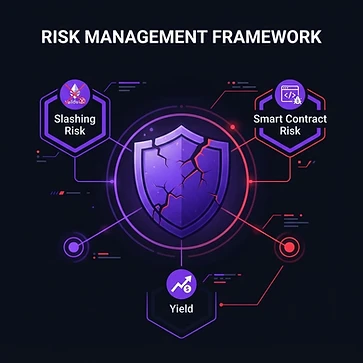
While the financial potential is clear, the risks of restaking are significant. The most prominent concern is 'slashing risk.' If the service you are validating experiences a bug, malicious activity, or a software failure, a portion of your restaked assets could be permanently lost through slashing penalties defined by that specific protocol.
Key Security Considerations
- Smart contract risk across multiple protocols.
- Aggregated slashing risk.
- Liquidity lock-up periods for certain AVS.
- Complexity of managing validator nodes.

Key Takeaways
- Restaking allows LST holders to earn additional yield by securing secondary protocols.
- EigenLayer provides the infrastructure for pooled security on Ethereum.
- Increased rewards come with increased risks, specifically the potential for protocol-level slashing.
- Users must evaluate the security audits and economic incentives of each AVS they support.
FAQ
Is restaking the same as liquid staking?
No. Liquid staking turns your locked ETH into a transferable token (like stETH). Restaking takes that liquid token and uses it to secure other protocols for extra yield.
What happens if I get slashed on EigenLayer?
If a protocol you are securing experiences a failure or malicious act, your restaked assets may be subject to slashing penalties, resulting in a loss of capital.
Is there a minimum requirement to restake?
While EigenLayer allows for flexible deposits, individual AVS or operators may have their own minimum thresholds for participation.
Comments (0)
Be the first to comment.