
Address Poisoning Scams: How to Protect Your Transfers
Learn how address poisoning scams work in crypto and discover essential security steps to protect your digital asset transfers from malicious actors today.
Understanding Address Poisoning in Crypto
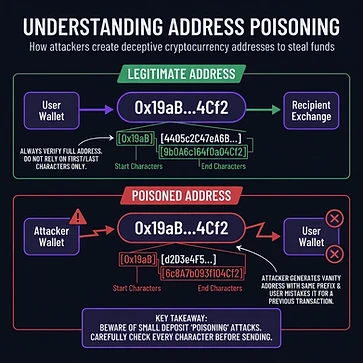
In the rapidly evolving landscape of blockchain technology, security is paramount. One of the most insidious threats currently targeting users is known as address poisoning. Address poisoning scams rely on the psychological behavior of users who copy and paste wallet addresses from their transaction history. By observing your blockchain activity, attackers send a negligible amount of cryptocurrency from a wallet that shares the same beginning and ending characters as your frequent contacts.
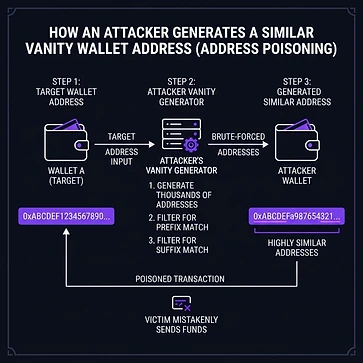
Because users often glance only at the first few and last few characters of an address, they may accidentally copy the attacker's address from their history instead of their intended recipient's address. This simple mistake leads to permanent loss of funds, as blockchain transactions are irreversible.
The Anatomy of an Address Poisoning Attack
Attackers use automated scripts to generate vanity addresses—addresses that mimic the prefixes or suffixes of your legitimate contacts. Once they identify a target, they "poison" the transaction history by sending zero-value or tiny-value transactions.
How the Deception Occurs
The goal is to clutter your recent activity list with addresses that look nearly identical to your own or those of your trusted platforms. When you prepare to send funds, you intuitively look at your recent history. If the attacker’s address is there, the risk of selecting it is high.
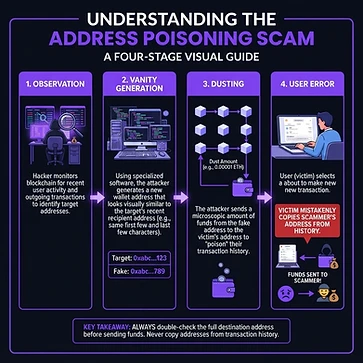

A Worked Example of the Scam
Imagine you regularly send ETH to a specific exchange wallet starting with 0xABC1...DEF9. An attacker monitoring the mempool detects your transaction. They generate a wallet 0xABC1...DEF9 and send 0.000000000000000001 ETH to your wallet. Later, you check your history to copy your exchange address. You see 0xABC1...DEF9, assume it is your trusted contact, and send 5 ETH to it. That 5 ETH is now in the attacker's wallet, and there is no way to reverse the transaction.
Best Practices for Secure Transfers
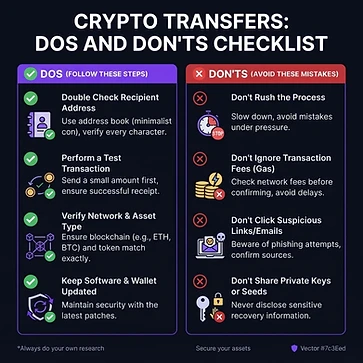
To safeguard your assets, you must shift how you interact with your wallet interface. Here are several non-negotiable security habits:
- Never Copy from History: Always use a saved address book or manually verify every character of the destination address before confirming.
- Use Address Book Features: Most reputable hardware and software wallets allow you to whitelist trusted addresses.
- Verify with Multiple Sources: If sending large amounts, send a small test transaction first to ensure the destination is correct.
- Ignore "Dust" Transactions: Seeing strange incoming transactions is common in crypto; do not interact with them.

Key Takeaways
- Address poisoning exploits human oversight by mimicking familiar wallet addresses.
- Attackers rely on you copying destination addresses directly from your recent transaction history.
- Always double-check every character of a wallet address, not just the start and end.
- Utilize internal wallet address books or contact whitelisting to store your primary destinations safely.
FAQ
Can address poisoning steal my private keys?
No. Address poisoning does not compromise your private keys, seed phrase, or wallet security. It is a social engineering attack that tricks you into voluntarily sending your funds to the wrong destination.
How can I remove poisoned addresses from my history?
Most blockchain explorers and wallet interfaces do not allow you to delete entries from your on-chain history because the blockchain is an immutable ledger. However, you can "hide" them in your wallet interface settings if your software supports it.

Is there any way to recover funds sent to a poisoned address?
Unfortunately, no. Because blockchain transactions are irreversible and decentralized, once you authorize a transfer, the network processes it immediately. There is no central authority to reverse the transaction or block the funds in the attacker's wallet.
Comments (0)
Be the first to comment.