
Bitcoin UTXOs and Coin Control: The Hidden Structure Behind Your Wallet Balance
Understand transaction inputs, change outputs and why many small deposits can affect future fees and privacy.
Your balance is a collection of spendable outputs
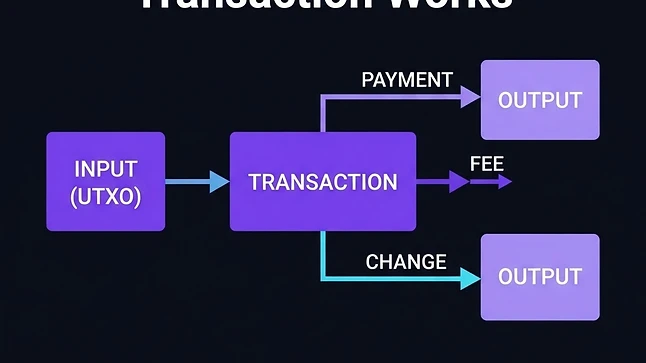
Bitcoin tracks unspent transaction outputs, commonly called UTXOs. A wallet's displayed balance is an aggregation of outputs that its keys can spend. Each output has a value and spending conditions; spending it consumes the output completely and creates new outputs.
This differs from editing a single account balance. A wallet may combine several inputs in one transaction or spend one larger output and return the remainder as change. The interface often hides this bookkeeping, but it influences both fees and privacy.
Follow an illustrative payment
Suppose your wallet selects a 0.010 BTC output to pay 0.003 BTC. If the transaction fee is 0.0001 BTC, it could create a 0.003 BTC payment output and a 0.0069 BTC change output. The fee is the difference between total input value and total output value.
This is a simplified example, not a recommended fee. Wallet policies, script types and fee conditions affect real construction. Good wallets generally generate a fresh change address rather than returning every remainder to the same address.
Why many small outputs may cost more to spend
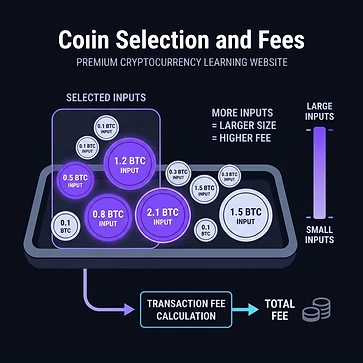
Fees are commonly expressed as satoshis per virtual byte. Adding inputs generally increases transaction size, so spending many small deposits may require a larger fee than spending one larger output of similar total value. Sending more BTC does not inherently require a proportionally larger network fee.
Coin control is a wallet feature that allows you to select particular outputs. It can help manage input count and keep funds from different sources separate, but careless selection can create awkward change or unintentionally combine sensitive histories.
Consolidation is a trade-off, not routine housekeeping
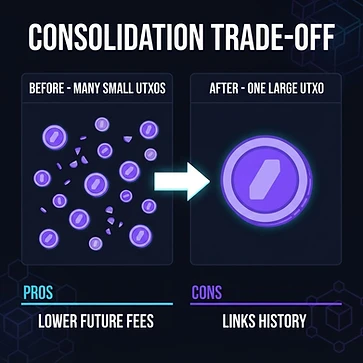

Consolidating several outputs into fewer outputs when fees are low may reduce future input requirements. However, consolidation itself costs a fee and can publicly link outputs that observers did not previously associate. There is no universal threshold at which every small output should be consolidated.
Dust also needs careful interpretation. Network relay policies define certain uneconomically small outputs, while the economic cost of spending any output changes with fees. An output can become expensive to spend without being permanently worthless.
Use wallet labels and deliberate selection
- Label incoming payments so you remember their purpose and origin.
- Check which inputs will be combined before a large spend.
- Review both destination and change handling in supported wallet interfaces.
- Estimate fees using current conditions, not an old fixed rule.
- Avoid consolidation solely because an unsolicited message tells you to act.
Bitcoin's ledger is public and pseudonymous, not anonymous. Common-input analysis can suggest relationships, although collaborative transaction types can complicate that inference. Coin control is therefore a tool for intentional transaction construction, not a guarantee that your activity cannot be linked.
Understanding UTXOs makes the wallet's balance less mysterious and helps you ask better questions about fees, privacy and the way a payment is assembled.
Educational content, not financial advice. Illustrations are AI-generated conceptual artwork.
Comments (0)
Be the first to comment.