
Liquidity Pools and Impermanent Loss: A Worked Example Before You Deposit
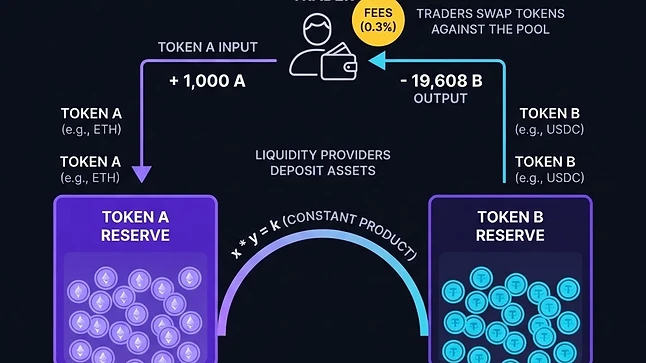
See why providing liquidity is not the same as holding tokens, and why fee income must be evaluated alongside changing asset exposure.
A liquidity provider takes both sides of a market
An automated market maker lets users trade against assets supplied to a pool. Liquidity providers receive a claim on some of those assets and may earn trading fees. Their token quantities change as traders interact with the pool. A deposit is therefore not equivalent to placing the same tokens untouched in a wallet.
In a simplified constant-product pool, the relationship between the two token reserves is x multiplied by y equals k. Trades change the reserve ratio and therefore the implied price. Real implementations may add concentrated ranges, different weighting, multiple assets or other mechanics.
Follow a simple price-change example
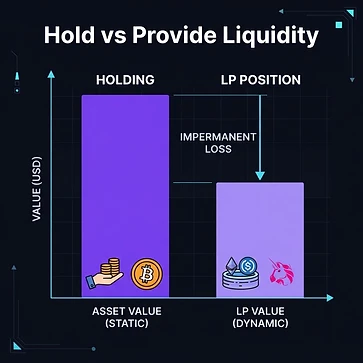
Imagine a simplified 50/50 constant-product position containing 1 ETH and 2,000 units of a dollar-pegged token when ETH costs $2,000. The starting value is $4,000. Ignore fees, incentives, gas and any stablecoin deviation.
If ETH rises to $4,000 and arbitrage aligns the pool with that price, the position would contain approximately 0.7071 ETH and 2,828.43 stablecoin units. Its total value would be approximately $5,656.85. Simply holding the original assets would instead be worth $6,000.
The position gained in dollar terms but underperformed holding by about $343.15, or 5.72%. This relative shortfall is commonly called impermanent loss. It can shrink if the price ratio returns, but the word impermanent does not mean the shortfall is guaranteed to disappear.
Fees can compensate, but they are uncertain
Trading fees may offset some or all of that difference. The result depends on volume, fee tier, liquidity competition and the path prices take. Reward tokens add another variable because their value can fall while headline yields look attractive.
Historical annualized returns are not forward guarantees. Compare net results after entry costs, exit costs and fees needed for position adjustments. An apparently profitable small position may be uneconomic once those costs are included.
Concentrated liquidity changes the exposure
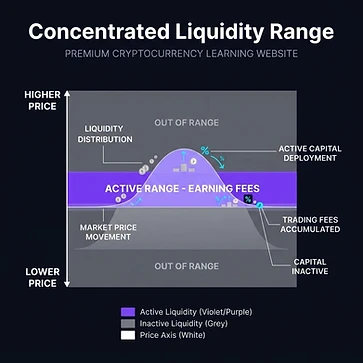

Some pools let providers choose a price range. Concentrating capital can increase its use inside that range, but it also makes outcomes more sensitive to price movement. Outside the active range, a position may become entirely one asset and stop earning ordinary active trading fees until conditions change.
The simple 50/50 calculation above does not describe every concentrated-liquidity position. Use the pool's actual design and a realistic scenario analysis rather than copying a formula across incompatible products.
Questions before depositing
- Would you be comfortable owning either asset alone?
- What happens if the relative price doubles or halves?
- Are fees organic, or does the return depend mainly on incentives?
- Can you monitor and afford any needed adjustments?
- What contract, governance, oracle or asset risks remain?
Liquidity provision is a form of market exposure with operational responsibilities. Understand the inventory you may end up holding before focusing on the advertised yield.
Illustrative calculations, not investment advice. Artwork is AI-generated.
Comments (0)
Be the first to comment.