
MEV and Sandwich Attacks: Why a Swap Can Execute at a Worse Price
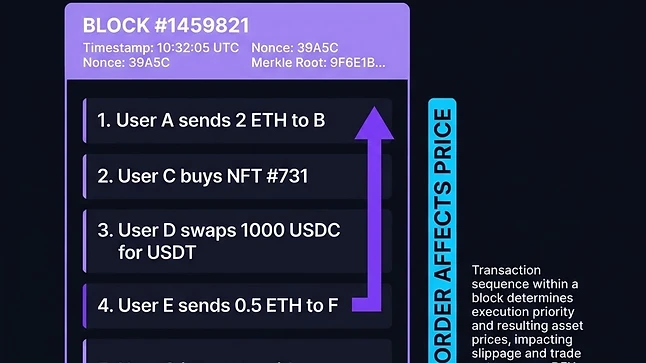
Learn how transaction ordering affects decentralized trades and what slippage limits can—and cannot—protect.
Transaction order has economic value
On a blockchain, the order in which transactions execute can change their results. Maximal extractable value, or MEV, describes value obtained by including, excluding or reordering transactions beyond ordinary transaction fees. Arbitrage between exchanges and certain liquidations are examples; MEV is not a synonym for theft, and not every form has the same effect on users.
A decentralized exchange calculates your output from the state of its pools when your trade executes. The quote you saw earlier is an estimate based on a different moment. Other trades, market movement and transaction ordering can change the final amount.
How a sandwich works
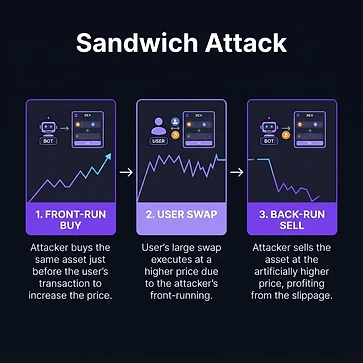
In a simplified sandwich attack, an actor trades before a visible swap, moving the pool price against that swap. The user's transaction then executes at a less favorable price. The actor trades again afterward, aiming to profit from the combined price movement after fees and other costs.
Thin liquidity and a generous slippage tolerance can make a trade more exposed. However, a poor execution price by itself does not prove an attack. Ordinary market changes, your own trade's price impact and routing choices can also explain the difference.
Price impact is not slippage tolerance
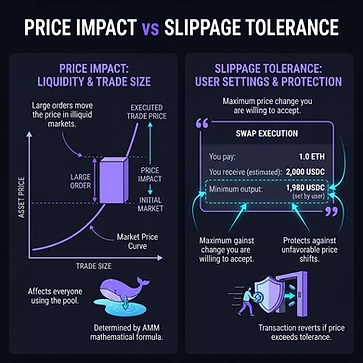
Price impact is the estimated change caused by your order consuming liquidity. Slippage tolerance is the maximum adverse deviation your trade permits relative to its quote. Tightening slippage does not remove your order's own impact, and setting it extremely low can cause failures in a moving market.
Suppose a quote offers 100 tokens and you allow 1% slippage. A simple minimum-output setting would permit approximately 99 tokens, subject to the interface's fee and quote conventions. This is an execution boundary, not a guarantee that the quote represents fair market value.
Reduce exposure without trusting a label blindly

- Compare expected output and price impact across suitable routes.
- Use a deliberate slippage limit instead of accepting a very high default.
- Read how any private routing or MEV-protection service works.
- Consider limit-order or auction mechanisms where appropriate.
- Recheck execution details after confirmation.
Private submission may reduce public visibility before inclusion, but it introduces assumptions about the provider and does not eliminate every form of MEV. Splitting a large order can change execution costs, yet repeated small orders also incur fees and can reveal a trading pattern. Neither technique is universally better.
Evaluate the whole execution
Record the quoted amount, minimum output, final output, network fee and route. This makes it easier to separate a market move from a liquidity problem. If a transaction repeatedly fails, diagnose the reason before increasing slippage: a larger tolerance can trade a failed execution for an unnecessarily expensive successful one.
Educational content, not investment advice. Illustrations are AI-generated conceptual artwork.
Comments (0)
Be the first to comment.