
Ethereum Gas Fees: What You Pay and How to Avoid Costly Mistakes

Understand gas units, base fees, tips and failed transactions before approving your next Ethereum transaction.
Gas is a measure of work, not a fixed transfer charge
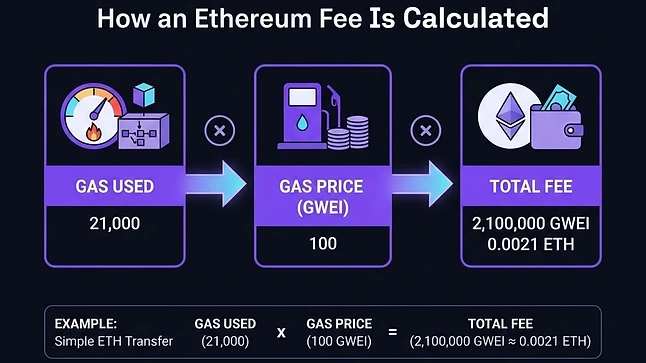
Ethereum charges for the computation and storage a transaction uses. Sending ETH, swapping tokens and minting an asset require different amounts of work. Gas units measure that work; the gas price determines how much each unit costs. A simple ETH transfer to a regular account typically uses 21,000 gas, while interactions with contracts can require much more.
A wallet usually estimates the gas limit for you. That limit is a ceiling on computational work, not a promise that every unit will be consumed. Setting it too low can make execution fail. Setting it higher does not make a transaction intrinsically faster, and insufficient funds to cover the required maximum can prevent submission.
Understand the components of your fee
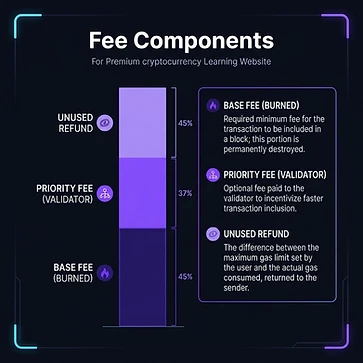

Under Ethereum's common fee model, the network sets a base fee that is burned. A priority fee compensates the validator. Your maximum fee per gas caps the amount you are willing to pay. The effective price is limited by that cap, so a maximum below the prevailing base fee can leave a transaction waiting.
For an illustrative transfer using 21,000 gas at an effective price of 20 gwei, the fee is 420,000 gwei, or 0.00042 ETH. Its dollar value changes with ETH's price. The maximum fee shown by a wallet is not necessarily the final charge; check the confirmed transaction receipt for gas used and effective gas price.
Why unsuccessful transactions can still cost money
A transaction that executes and then reverts has still consumed network resources, so it usually pays for that work even though the intended state changes are reversed. A transaction rejected before inclusion is different. Errors can result from expired quotes, missing allowances, contract conditions or an inadequate gas limit.
Repeatedly submitting the same action without reading the failure reason can turn one mistake into several fees. A pending transaction may be replaceable using the same nonce and an adequate fee increase, but replacement rules depend on the wallet and network conditions; cancellation is not guaranteed.
A practical preflight checklist

- Confirm the destination network and keep its native fee token available.
- Read the estimated total fee rather than only a speed label.
- Inspect what the contract will do and which assets it can spend.
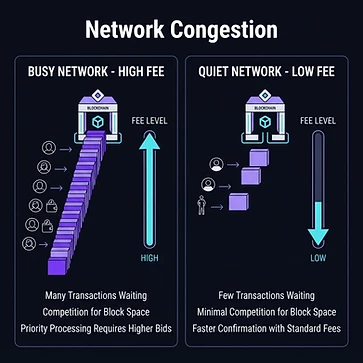
- If the action is not urgent, compare fees at a quieter time.
- Consider a suitable layer-2 network, accounting for bridging costs and its security assumptions.
Layer-2 fees may include both execution and data-posting charges, so Ethereum mainnet arithmetic does not always describe the full bill. The goal is not the lowest fee at any cost: a correctly reviewed transaction is more important than saving a small amount on execution.
Educational content, not investment advice. Illustrations are AI-generated conceptual artwork.
Comments (0)
Be the first to comment.