
Fundamental Analysis of Cryptocurrencies: Evaluating Real Value
Learn how to evaluate a cryptocurrency beyond its price — tokenomics, whitepapers, market metrics, and on-chain data that reveal true project quality.
Beyond Price: What Fundamental Analysis Means in Crypto
Technical analysis tells you when to buy. Fundamental analysis tells you what to buy. In traditional finance, fundamental analysis examines earnings, revenue, and competitive position. In crypto, the metrics are different but the principle is the same: assess the intrinsic value of a project to determine if it's undervalued or overvalued.
1. Tokenomics: The Economics of a Token
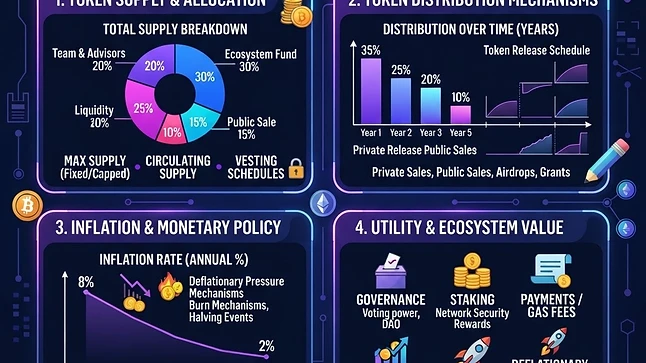
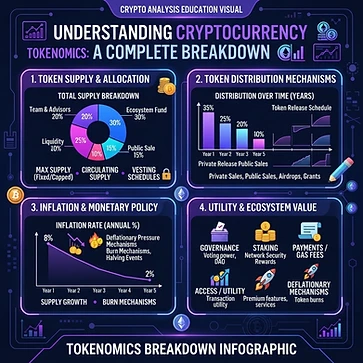
Tokenomics (token economics) examines the design and mechanics of a cryptocurrency. Poor tokenomics can doom an otherwise promising project. Key factors:
Supply Metrics
- Total supply — The maximum number of tokens that will ever exist.
- Circulating supply — Tokens currently in circulation.
- Inflation rate — How quickly new tokens are being created. High inflation puts downward pressure on price.
- Burn mechanisms — Some projects permanently destroy tokens to reduce supply.
Distribution
- Allocation — How tokens are distributed among team, investors, community, and treasury. Concentrated holdings in a few wallets are a red flag.
- Vesting schedules — When team and investor tokens unlock. Large unlocks can cause selling pressure.
- Fair launch vs. pre-mine — Fair launches (like Bitcoin) distribute tokens through mining/usage. Pre-mines give founders tokens before public launch.
Utility
- What is the token used for? Governance, staking, fee payment, access to services?
- Does the token have a real reason to exist? Many projects issue tokens that add no value beyond speculation.
- Value capture — Does the protocol's revenue flow to token holders, or does it go elsewhere?
2. The Whitepaper


The whitepaper is the foundational document of any crypto project. A thorough whitepaper analysis reveals whether a project is built on solid foundations or marketing hype.
Key Sections to Evaluate
- Problem Statement — Is the problem real and significant? Does it actually require blockchain to solve?
- Solution — Is the proposed solution technically sound? Is it better than existing alternatives?
- Technology — Is the architecture well-explained? Are there technical innovations or is it rehashing existing tech?
- Tokenomics — Is the token model well-designed? Does the token have genuine utility?
- Team — Are the founders experienced? Do they have relevant backgrounds? Are they public or anonymous?
- Roadmap — Are milestones realistic? Has the team delivered on past promises?
- Governance — How are decisions made? Is the process transparent and decentralized?
Red Flags
- Vague or overly technical language designed to impress rather than explain.
- No clear use case for the token.
- Anonymous team with no track record.
- Unrealistic promises of returns.
- Copy-pasted sections from other whitepapers.
- No mention of risks or challenges.
3. Market Metrics

Market Capitalization
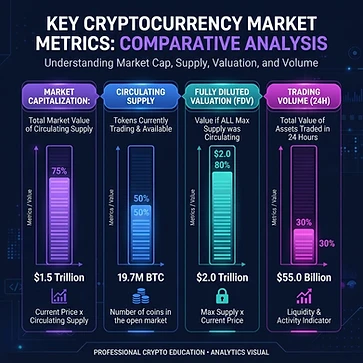
Market cap = Current price × Circulating supply. It measures the total value of a cryptocurrency.
- Large-cap (> $10B) — Generally more stable, lower risk. Examples: Bitcoin, Ethereum.
- Mid-cap ($1B-$10B) — Moderate risk and growth potential.
- Small-cap (< $1B) — High risk, high potential reward. Many will fail.
Fully Diluted Valuation (FDV)
FDV = Current price × Total supply. If FDV is much higher than market cap, significant token unlocks are coming — potential selling pressure.
Trading Volume
- 24-hour volume — Higher volume indicates better liquidity and more reliable price discovery.
- Volume-to-market-cap ratio — A ratio above 10% suggests healthy trading activity. Below 2% may indicate low interest.
Exchange Listings
Being listed on major exchanges (Binance, Coinbase) increases accessibility and liquidity. Check which exchanges list the token and whether listings are recent.
4. On-Chain Analysis
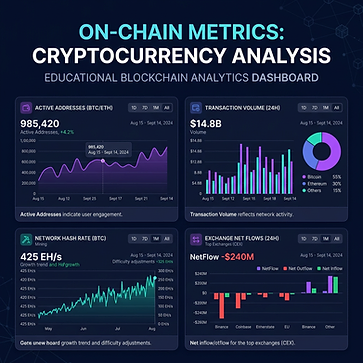

On-chain analysis examines data recorded on the blockchain itself — the most transparent and tamper-proof source of information in crypto.
Key On-Chain Metrics
- Active addresses — The number of unique addresses transacting daily. Rising active addresses indicate growing adoption.
- Transaction volume — The total value of transactions. Increasing volume suggests growing economic activity.
- Hash rate (for PoW networks) — A measure of network security. Rising hash rate means the network is becoming more secure.
- Staking rate (for PoS networks) — The percentage of tokens staked. High staking rates indicate long-term holder conviction.
- Exchange flows — Tokens moving to exchanges often signal selling pressure; tokens leaving exchanges suggest accumulation.
- Whale concentration — The percentage of supply held by large holders. High concentration is a risk — whales can move the market.
- MVRV ratio (Market Value to Realized Value) — Compares market cap to the cost basis of all coins. High MVRV (> 3) historically indicates market tops; low MVRV (< 1) indicates bottoms.
Tools for On-Chain Analysis
- Glassnode — Professional-grade on-chain metrics.
- CryptoQuant — Exchange flows and miner data.
- Santiment — Social sentiment and on-chain metrics.
- Dune Analytics — Community-built dashboards.
- Token Terminal — Protocol revenue and usage data.
5. The Team and Community
Team Evaluation
- Track record — Have they built successful projects before?
- Transparency — Are they public and accessible, or hiding behind anonymity?
- Activity — Check GitHub for development activity. Consistent commits indicate active development.
- Advisors — Do respected figures in the space advise the project?
Community Assessment
- Social media presence — Active, genuine communities (not bought followers).
- Developer community — Are external developers building on the platform?
- Governance participation — High voter turnout in governance proposals indicates engaged stakeholders.
- Sentiment — Use tools like LunarCrush to measure social sentiment, but be wary of coordinated hype.
6. Competitive Analysis
No cryptocurrency exists in isolation. Evaluate a project against its competitors:
- Differentiation — What makes this project better than alternatives?
- Network effects — Does the project benefit from being the largest in its category?
- Switching costs — How easy is it for users to migrate to a competitor?
- Moats — Technical advantages, brand recognition, partnerships, or regulatory positioning that protect against competition.
Putting It All Together
Fundamental analysis is not a checklist you complete once — it's an ongoing process. Projects evolve, markets change, and new information emerges. Build a thesis for each investment:
- What problem does this project solve?
- Is the solution technically sound and needed?
- Are the tokenomics aligned with long-term holders?
- Is the team capable and trustworthy?
- Does the on-chain data support the narrative?
- Is the current valuation reasonable relative to fundamentals?
If you can't answer these questions confidently, you're speculating, not investing. There's nothing wrong with speculation — but do it with eyes open and position sizes that reflect the risk.
The crypto market is full of projects that will change the world and projects that will go to zero. Fundamental analysis is your best tool for telling them apart.
Comments (0)
Be the first to comment.