
DeFi Explained: The Future of Decentralized Finance
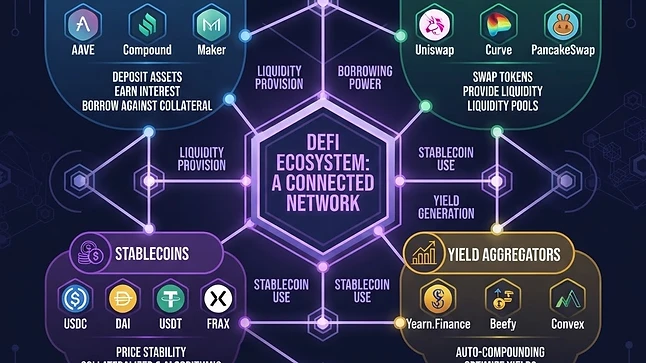
From lending and borrowing to yield farming and DEXs — understand how DeFi is rebuilding the financial system without banks.
What Is DeFi?
Decentralized Finance (DeFi) refers to financial applications built on blockchain networks — primarily Ethereum — that operate without traditional intermediaries like banks, brokerages, or insurance companies. Instead, smart contracts automatically execute financial transactions according to predefined rules.
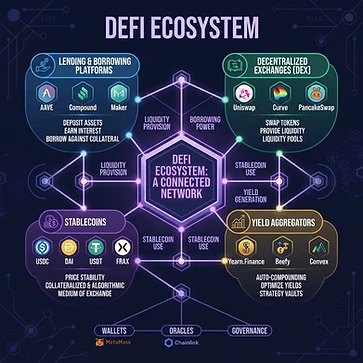
The total value locked (TVL) in DeFi protocols has grown from virtually nothing in 2018 to tens of billions of dollars, making it one of the most significant innovations in the crypto space.
The Building Blocks of DeFi
Smart Contracts
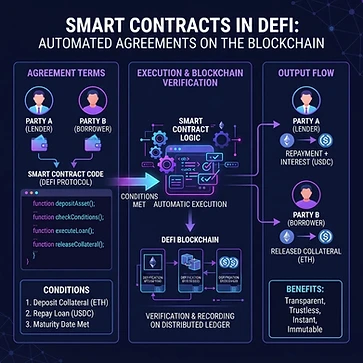

Smart contracts are self-executing programs stored on the blockchain. They automatically enforce the terms of an agreement when conditions are met. In DeFi, smart contracts replace the role of traditional financial intermediaries.
For example, a lending smart contract might automatically:
- Accept deposits and pay interest to lenders.
- Issue loans to borrowers who provide sufficient collateral.
- Liquidate positions if collateral value drops below a threshold.
All of this happens without human intervention, 24/7, with complete transparency.
Stablecoins
Stablecoins are cryptocurrencies pegged to stable assets (usually the US dollar), providing the price stability needed for financial applications. Major types:
- Fiat-backed (USDC, USDT) — Reserves of fiat currency back each token.
- Crypto-backed (DAI) — Overcollateralized with cryptocurrency.
- Algorithmic — Use algorithms to maintain the peg (higher risk).
Key DeFi Categories
1. Decentralized Exchanges (DEXs)
DEXs allow users to trade cryptocurrencies directly with each other without a centralized intermediary. Instead of an order book matching buyers and sellers, most DEXs use automated market makers (AMMs).
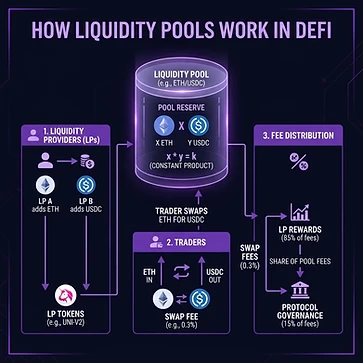

Liquidity Pools
A liquidity pool is a smart contract that holds pairs of tokens. Users called liquidity providers (LPs) deposit equal values of both tokens into the pool. In return, they receive LP tokens representing their share of the pool and earn trading fees.
When a trader wants to swap Token A for Token B, the AMM uses a mathematical formula (typically x × y = k) to determine the price based on the ratio of tokens in the pool. This means prices shift as trades occur — larger trades cause more slippage.
Popular DEXs: Uniswap, Curve, PancakeSwap, Balancer.
2. Lending and Borrowing
DeFi lending platforms allow users to earn interest by supplying assets or borrow against their crypto holdings. Interest rates are algorithmically set based on supply and demand.
How it works:
- You deposit crypto as collateral (usually overcollateralized — you can borrow less than you deposit).
- You receive a loan in another asset.
- You pay interest on the borrowed amount.
- If your collateral value drops too low, your position is liquidated.
Popular platforms: Aave, Compound, MakerDAO.
3. Yield Farming
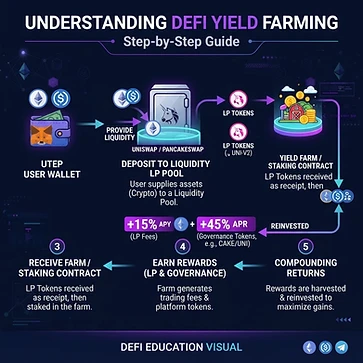

Yield farming (also called liquidity mining) involves strategically moving assets between DeFi protocols to maximize returns. Farmers earn rewards from:
- Trading fees from liquidity pools.
- Protocol token rewards (e.g., UNI, COMP) distributed to users.
- Interest from lending platforms.
- Stacking returns by using LP tokens as collateral in other protocols.
Yield farming can generate high returns but carries significant risks. APYs (Annual Percentage Yields) can range from modest single digits to eye-watering triple digits — but high returns always mean high risk.
4. Derivatives and Synthetics
DeFi derivatives platforms allow trading synthetic assets that track the price of real-world assets — stocks, commodities, fiat currencies — without owning the underlying asset. Platforms like Synthetix and dYdX enable:
- Perpetual futures with leverage.
- Options trading.
- Synthetic stocks and commodities.
The Risks of DeFi
DeFi is powerful but carries unique risks that traditional finance doesn't:
Smart Contract Risk
A bug in a smart contract can lead to permanent loss of funds. Unlike a bank error, there's no customer service to call. Mitigation: Use audited protocols, diversify across platforms, and avoid brand-new unaudited projects.
Impermanent Loss
When providing liquidity, if the price ratio of your token pair changes significantly, you may end up with less value than if you'd simply held the tokens. This is called impermanent loss (it becomes permanent if you withdraw).
Liquidation Risk
In lending protocols, if your collateral's value drops below the required threshold, your position is liquidated — often at a penalty. Always maintain a healthy collateralization ratio.
Oracle Risk
Many DeFi protocols rely on oracles (data feeds) for price information. If an oracle is manipulated or fails, it can trigger incorrect liquidations or trades.
Regulatory Risk
DeFi operates in a regulatory gray area. Future regulations could impact how protocols operate, potentially affecting your funds.
Getting Started with DeFi
- Start small — Experiment with small amounts while you learn.
- Use established protocols — Stick to well-known, audited platforms.
- Understand before you act — Never interact with a protocol you don't understand.
- Use a dedicated wallet — Separate your DeFi activity from your main holdings.
- Revoke approvals — After using a protocol, revoke its access to your tokens.
- Stay informed — Follow DeFi news and be aware of protocol upgrades and governance decisions.
The Future of DeFi
DeFi is still in its early stages, comparable to the internet in the 1990s. Current challenges — scalability, user experience, regulatory clarity — are being actively addressed. Layer-2 solutions (Arbitrum, Optimism, Polygon) are reducing fees and increasing speed. Cross-chain protocols are connecting previously isolated ecosystems.
The vision of DeFi is an open, transparent, and accessible financial system available to anyone with an internet connection. Whether that vision fully materializes remains to be seen, but the innovation happening in this space is undeniable and worth understanding.
Comments (0)
Be the first to comment.