
Risk Management in Crypto Trading: Protecting Your Capital
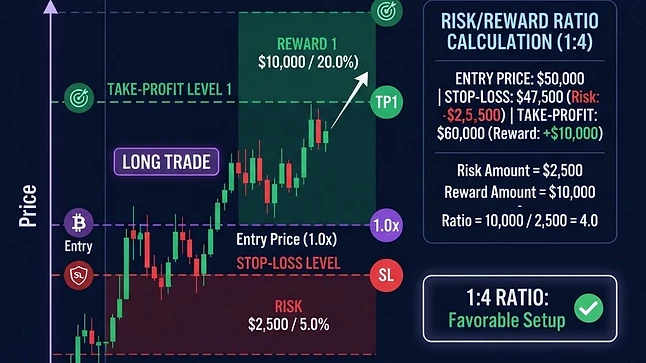
The single most important skill in trading isn't picking winners — it's managing losses. Learn position sizing, stop-losses, and portfolio diversification.
Why Risk Management Matters More Than Strategy
Most new traders focus on finding winning trades, but professional traders know that risk management is what separates success from failure. You can be right 60% of the time and still lose money if your losses are larger than your wins. Conversely, you can be right only 40% of the time and be highly profitable with proper risk management.
The Risk-Reward Ratio
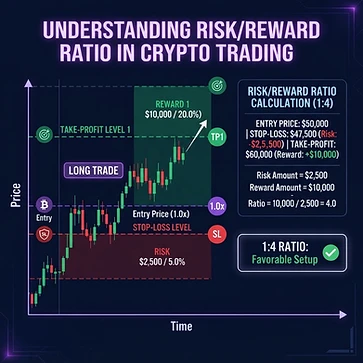
The risk-reward ratio (RRR) compares the potential loss of a trade to its potential gain. For example, if you risk $100 to make $300, your RRR is 1:3.
A good rule of thumb is to aim for at least a 1:2 ratio. This means even if you're right only 40% of the time, you'll be profitable:
- 10 trades × $100 risk = $1,000 total risk
- 4 wins × $200 reward = $800
- 6 losses × $100 loss = $600
- Net profit: $200
Position Sizing
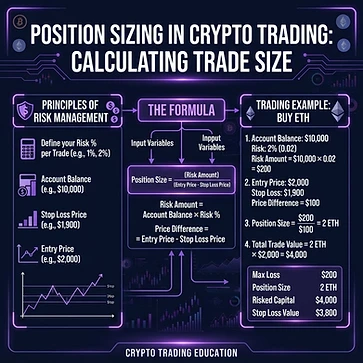

Position sizing determines how much capital to allocate to each trade. The golden rule: never risk more than 1-2% of your total capital on a single trade.
The Formula
Position Size = (Account Balance × Risk %) / (Entry Price - Stop Loss Price)
Example:
- Account balance: $10,000
- Risk per trade: 1% = $100
- Entry price: $50,000
- Stop loss: $48,000 (4% below entry)
- Position size = $100 / $2,000 = 0.05 BTC
This ensures that even a string of losses won't wipe out your account. With 1% risk, you'd need to lose 100 consecutive trades to lose everything — statistically nearly impossible with a reasonable strategy.
Stop-Loss Strategies
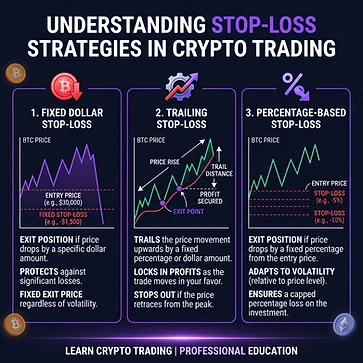

A stop-loss is an order that automatically sells your position when the price reaches a predetermined level. It's your safety net.
Types of Stop-Losses
- Fixed stop-loss — Set at a specific price based on your risk tolerance. Simple and effective.
- Trailing stop — Moves up as the price rises, locking in profits while giving the trade room to breathe. For example, a 10% trailing stop on a position that's gone from $100 to $150 would sit at $135.
- Volatility-based stop (ATR) — Uses the Average True Range indicator to set stops based on market volatility. Wider stops in volatile markets, tighter in calm ones.
- Time-based stop — Exits the trade if it hasn't moved in your favor within a set time, regardless of price.
Common Mistakes
- Moving your stop-loss further away when the trade goes against you. This turns a planned small loss into a catastrophic one.
- Not using a stop-loss at all. In crypto's volatile markets, this is gambling, not trading.
- Setting stops too tight. Normal market noise will trigger them, causing death by a thousand cuts.
Portfolio Diversification


Diversification spreads risk across multiple assets, reducing the impact of any single asset's poor performance. A well-diversified crypto portfolio might include:
- Bitcoin (40-50%) — The foundation. Lower volatility, highest liquidity.
- Ethereum (20-30%) — The leading smart contract platform.
- Large-cap altcoins (10-20%) — Established projects with real use cases.
- Small-cap / speculative (5-10%) — High risk, high potential reward.
- Stablecoins (5-10%) — Dry powder for buying opportunities.
Correlation Matters
Diversification only works if your assets aren't perfectly correlated. During market crashes, most cryptocurrencies move together. True diversification might include non-crypto assets (stocks, bonds, real estate, gold).
The Psychology of Risk
Risk management is as much psychological as it is mathematical:
- Fear of missing out (FOMO) — Leads to chasing prices and abandoning your plan.
- Revenge trading — Trying to recover losses quickly by increasing risk. This is how small losses become account-destroying ones.
- Overconfidence — A string of wins can make you feel invincible. Stick to your rules.
- Loss aversion — The pain of losing is psychologically twice as strong as the joy of winning. Accept losses as a normal cost of trading.
Key Principles to Remember
- Capital preservation comes first. You can't trade if you have no capital.
- Plan the trade before you enter it. Know your entry, stop-loss, and take-profit levels.
- Never risk more than you can afford to lose. Crypto is volatile — be prepared for the worst.
- Keep a trading journal. Record every trade, the reasoning behind it, and the outcome. Patterns will emerge.
- Emotions are your enemy. A written trading plan removes decisions in the heat of the moment.
Risk management won't make you rich overnight, but it will keep you in the game long enough to become profitable. In trading, survival is success.
Comments (0)
Be the first to comment.