
Understanding Blockchain Technology: How It Actually Works
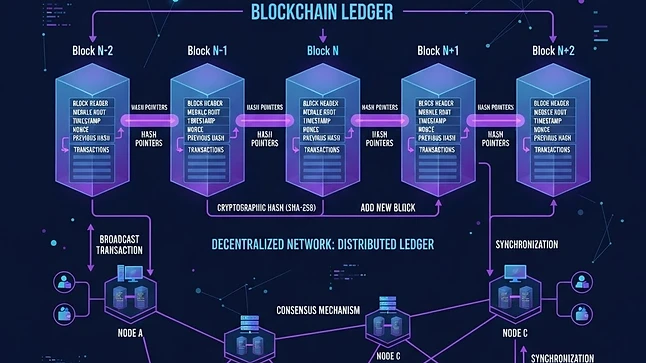
A deep dive into the technology behind cryptocurrencies — blocks, consensus mechanisms, and how transactions are verified without a central authority.
What Is a Blockchain?
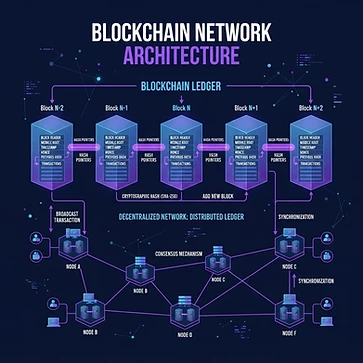
A blockchain is a distributed, immutable ledger that records transactions across a network of computers. Unlike a traditional database controlled by a single entity, a blockchain is maintained by thousands of nodes worldwide, making it transparent, tamper-resistant, and decentralized.
The Structure of a Block
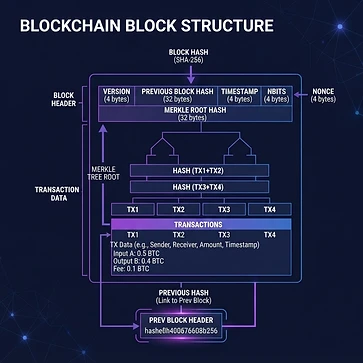
Each block in a blockchain contains three key elements:
- Data — The transactions stored in the block (sender, receiver, amount).
- Hash — A unique fingerprint of the block, generated using cryptographic algorithms.
- Previous Hash — The hash of the block that came before it, creating the chain.
This chain structure is what makes blockchain secure. If someone tries to alter a block, its hash changes, which breaks the link to all subsequent blocks. Every node on the network would immediately detect the tampering.
The Merkle Tree
Inside each block, transactions are organized into a Merkle tree — a data structure that efficiently summarizes all transactions into a single root hash. This allows nodes to verify whether a specific transaction is included in a block without downloading the entire blockchain.
How Transactions Work
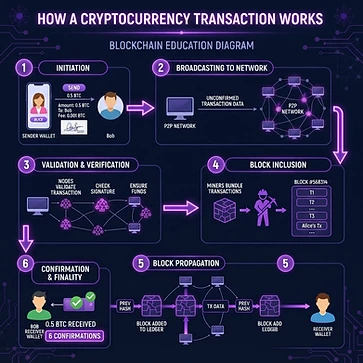

When you send cryptocurrency, the following process occurs:
- Initiation — You create a transaction using your wallet, signing it with your private key.
- Broadcast — The transaction is sent to the network of nodes.
- Validation — Nodes verify that you have sufficient funds and the signature is valid.
- Mempool — Valid transactions wait in the mempool (memory pool) to be included in the next block.
- Block Creation — A miner or validator selects transactions from the mempool and includes them in a new block.
- Confirmation — Once the block is added to the chain, the transaction is confirmed. More blocks on top make it increasingly irreversible.
Consensus Mechanisms
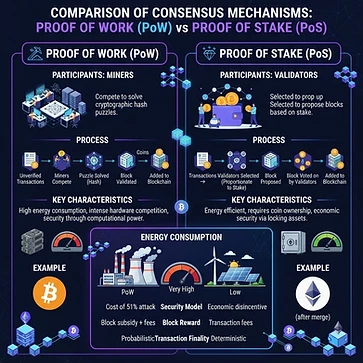

Since there's no central authority, blockchains need a way for nodes to agree on the state of the ledger. This is called a consensus mechanism.
Proof of Work (PoW)
Used by Bitcoin, PoW requires miners to solve complex mathematical puzzles to add new blocks. The first miner to solve the puzzle earns the right to add the block and receives a reward.
- Pros — Battle-tested security, highly decentralized.
- Cons — Energy-intensive, slower transaction throughput.
Proof of Stake (PoS)
Used by Ethereum and many newer blockchains, PoS selects validators based on the amount of cryptocurrency they've staked as collateral. Validators are chosen to create new blocks proportionally to their stake.
- Pros — Energy-efficient, faster transactions, enables staking rewards.
- Cons — Critics argue it favors wealthy holders ("the rich get richer").
Other Mechanisms
- Delegated Proof of Stake (DPoS) — Token holders vote for delegates who produce blocks.
- Proof of Authority (PoA) — Pre-approved validators take turns producing blocks.
- Proof of History (PoH) — Used by Solana, adds a cryptographic timestamp to improve speed.
Why Blockchain Matters
Blockchain solves the double-spending problem — the challenge of ensuring digital money isn't spent twice without a central authority. This breakthrough enables:
- Trustless transactions — You don't need to trust the other party; the math guarantees it.
- Censorship resistance — No single entity can block transactions.
- Transparency — All transactions are publicly verifiable.
- Immutability — Once recorded, data cannot be altered.
Beyond Cryptocurrency
Blockchain technology extends far beyond digital money:
- Supply chain tracking — Verifying product origins and authenticity.
- Smart contracts — Self-executing agreements without intermediaries.
- Digital identity — Self-sovereign identity management.
- Tokenization — Representing real-world assets (real estate, art) on-chain.
The Future of Blockchain
Blockchain is still in its early stages. Challenges remain — scalability, energy consumption, and regulatory uncertainty. But solutions like layer-2 networks (Lightning Network, rollups) and sharding are actively being developed. Understanding the fundamentals of blockchain technology positions you to understand the innovations that will shape the next decade of finance and beyond.
Comments (0)
Be the first to comment.