
Crypto Security: Protecting Your Digital Assets
Essential security practices every crypto holder must know — from phishing defense to hardware wallet best practices.
The crypto space is a tempting target for criminals. Unlike traditional banking, where fraud protection and chargebacks exist, cryptocurrency transactions are irreversible — once your funds are stolen, they're gone forever. This guide covers the essential security practices every crypto holder must implement to protect their digital wealth.

The Security Mindset
The first principle of crypto security: you are your own bank. This means you have complete control — and complete responsibility. There's no customer service to call if you lose your keys or send funds to the wrong address.
Common Threats and How to Avoid Them
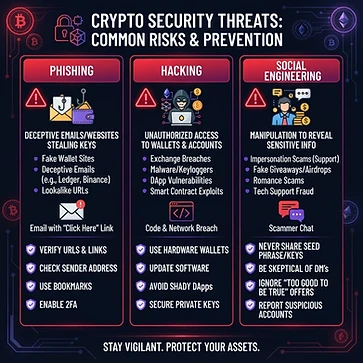

1. Phishing Attacks
Phishing is the most common crypto attack. Scammers create fake websites, emails, or messages that mimic legitimate services to steal your credentials.
How to protect yourself:
- Always verify URLs — bookmark legitimate exchange and wallet sites
- Never click links in unsolicited emails or messages
- Check for HTTPS and valid SSL certificates
- Be suspicious of urgency — scammers create false time pressure
2. Malware and Clipboard Hijacking
Malware can replace a wallet address you've copied with the attacker's address. When you paste and send, your funds go to the thief.
How to protect yourself:
- Always visually verify the first and last 4-6 characters of an address after pasting
- Use a hardware wallet for large transactions — it displays the address on the device screen
- Keep your operating system and antivirus updated
3. Social Engineering
Attackers may impersonate support staff, friends, or influencers to gain your trust and access to your funds.
How to protect yourself:
- No legitimate support will ask for your private keys or seed phrase
- Verify identities through official channels, not DMs
- Be skeptical of "too good to be true" investment opportunities
Best Practices Summary
- Use a hardware wallet for significant holdings
- Never store your seed phrase digitally — write it on paper and store it securely
- Enable 2FA everywhere (use an authenticator app, not SMS)
- Use a dedicated email for crypto accounts
- Separate your hot and cold storage — daily spending funds in hot wallet, savings in cold storage
- Regularly audit your security practices
Security is not a destination — it's a continuous practice. The threat landscape evolves constantly, and so should your defenses. By implementing these practices, you'll be far harder to target than the vast majority of crypto users.
Comments (0)
Be the first to comment.