
What is DeFi? A Guide to Decentralized Finance
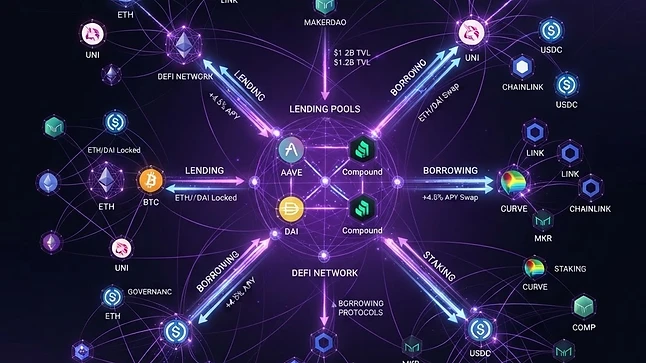
Discover how decentralized finance is reshaping the financial world — lending, borrowing, and earning without traditional banks.
Decentralized Finance (DeFi) is one of the most revolutionary applications of blockchain technology. It refers to financial services — lending, borrowing, trading, and earning interest — that operate without traditional intermediaries like banks, brokerages, or exchanges. Instead, DeFi uses smart contracts on blockchains to automate financial transactions.
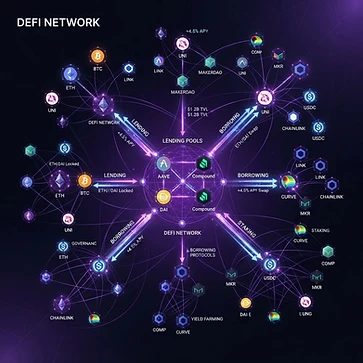
How DeFi Works
DeFi applications (called "dApps") run on smart contract platforms like Ethereum. A smart contract is a self-executing piece of code that automatically enforces the rules of a financial agreement. There's no need for a bank to approve your loan or a broker to execute your trade — the code does it all.
Key Advantages of DeFi:
- Permissionless: Anyone with an internet connection can access DeFi
- Transparent: All transactions are visible on the blockchain
- Global: No geographic restrictions
- 24/7: Markets never close
- Programmable: Complex financial products can be built with code
The DeFi Ecosystem
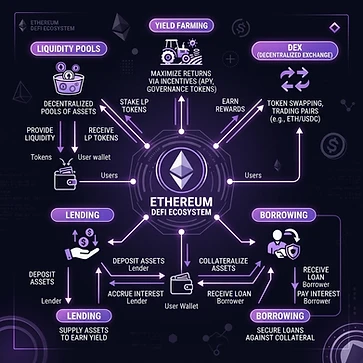

Decentralized Exchanges (DEXs)
DEXs like Uniswap and Curve allow you to trade cryptocurrencies directly with other users without a central intermediary. They use automated market makers (AMMs) — liquidity pools that set prices based on supply and demand.
Lending and Borrowing
Platforms like Aave and Compound let you lend your crypto to earn interest or borrow against your holdings. Interest rates are set algorithmically based on supply and demand.
Yield Farming
Yield farming involves providing liquidity to DeFi protocols in exchange for rewards. It's a way to earn passive income on your crypto holdings, but carries significant risks.
Risks to Understand
DeFi is still an emerging space with important risks:
- Smart contract bugs: A single code error can lead to permanent loss of funds
- Impermanent loss: Providing liquidity can result in unexpected losses
- Liquidation risk: Borrowing against volatile collateral can lead to forced liquidation
- Regulatory uncertainty: Laws governing DeFi are still evolving
DeFi represents a fundamental shift in how financial services can be delivered. While the risks are real, the potential to create a more open, accessible financial system makes it one of the most exciting areas in crypto.
Comments (0)
Be the first to comment.