
What is Blockchain? Understanding the Technology Behind Crypto

Explore the foundational technology of cryptocurrencies — how blockchain works, why it's revolutionary, and its applications beyond digital money.
Blockchain is the foundational technology behind all cryptocurrencies. At its core, a blockchain is a distributed database that maintains a continuously growing list of records, called blocks, which are linked and secured using cryptography. Understanding blockchain is essential for anyone entering the world of digital assets.


How Blockchain Works
Each block in a blockchain contains:
- Transaction data — the records of who sent what to whom
- A hash — a unique digital fingerprint of the block's contents
- The previous block's hash — this links blocks together in a chain
This linking is what makes blockchain tamper-proof. If someone tries to alter a block, its hash changes, which breaks the link to all subsequent blocks. The network would immediately detect this tampering.
The Consensus Mechanism
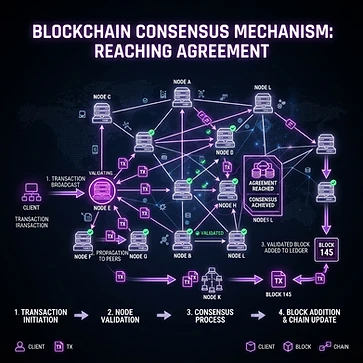

For a distributed network to agree on the state of the blockchain, it needs a consensus mechanism. The two most common are:
Proof of Work (PoW)
Used by Bitcoin, PoW requires miners to solve complex mathematical puzzles to add new blocks. It's highly secure but energy-intensive.
Proof of Stake (PoS)
Used by Ethereum and many newer blockchains, PoS allows validators to create blocks based on the amount of cryptocurrency they've staked as collateral. It's more energy-efficient and enables faster transactions.
Why Blockchain Matters
Blockchain solves a fundamental problem: how to establish trust in a digital world without a central authority. This has implications far beyond cryptocurrency:
- Supply chain tracking — verify product authenticity from origin to consumer
- Smart contracts — self-executing agreements with no intermediary
- Digital identity — secure, user-controlled identity verification
- Voting systems — transparent and tamper-proof elections
Blockchain represents a shift from trusting institutions to trusting mathematics. As the technology matures, its impact will extend far beyond the financial sector into every industry that relies on trust and verification.
Comments (0)
Be the first to comment.