
Moving Averages: A Trader's Guide
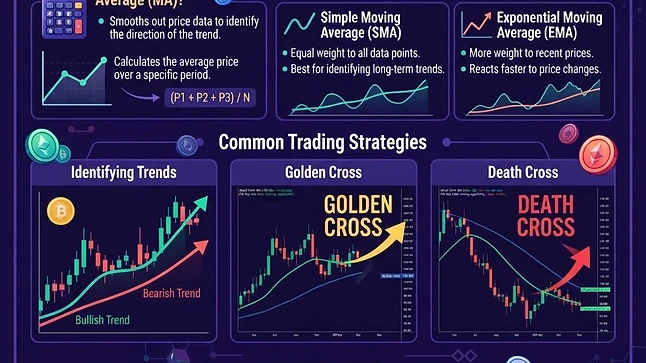
Moving averages help traders smooth out noisy crypto price action and spot trend direction more clearly. This guide explains the most common types of moving averages and how beginners can use them in real trading setups.
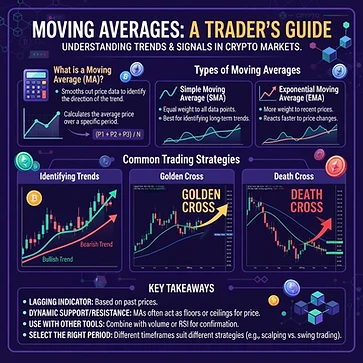
Moving averages are one of the easiest and most useful tools for crypto traders. They smooth price data over time, making it easier to identify trends and avoid reacting to every short-term price swing. For beginners, they can provide structure without adding too much complexity.
What a moving average does
A moving average calculates the average price over a set number of periods. As new candles form, the average updates, creating a line that follows price.
Common examples include:
- 9-period moving average
- 20-period moving average
- 50-period moving average
- 200-period moving average
Shorter moving averages react faster to price changes, while longer ones move more slowly and show the bigger trend.
Two main types
The two most common types are:
- Simple Moving Average (SMA): Gives equal weight to all prices in the period
- Exponential Moving Average (EMA): Gives more weight to recent prices, so it reacts faster
Many crypto traders prefer EMAs for short-term trading because they respond more quickly in fast markets.
Practical ways to use moving averages
Beginners often use moving averages for:
- Trend direction: Price above the moving average may suggest an uptrend
- Dynamic support or resistance: Price may react to the line during pullbacks
- Crossovers: A shorter moving average crossing above a longer one can suggest strength
- Trade filtering: Only taking long trades when price is above a key average
A simple example is using the 50 EMA to define trend, then looking for entries when price pulls back and holds above it.
Useful combinations
You do not need many moving averages. A practical setup could be:
- 20 EMA for short-term direction
- 50 EMA for medium-term trend
- 200 SMA for long-term market structure
This gives enough context without cluttering the chart.
Common mistakes
- Using too many moving averages at once
- Treating crossovers as automatic buy or sell signals
- Ignoring support, resistance, and volume
- Using moving averages in sideways markets without caution
Best beginner habit
Use moving averages as a guide, not as a complete strategy. Combine them with chart structure and risk management. When used simply, moving averages can help you stay aligned with the trend and avoid low-quality trades.
Comments (0)
Be the first to comment.