
The Role of Oracles in DeFi
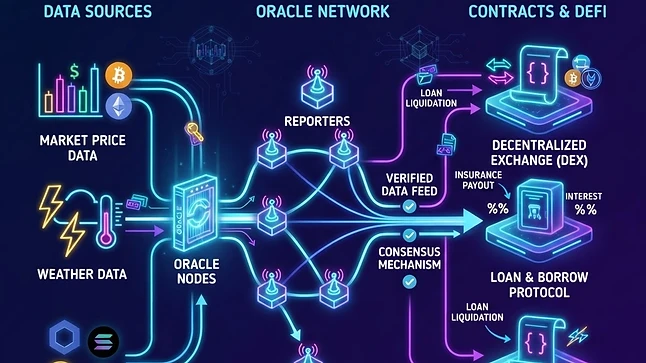
Oracles connect blockchains to real-world information such as prices, weather, or event results. In DeFi, they are essential because smart contracts cannot reliably access outside data on their own.
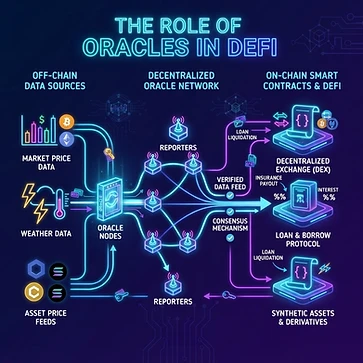
Smart contracts are powerful, but they have an important limitation: they cannot directly fetch real-world data from the internet by themselves. This is where oracles come in. Oracles deliver outside information to blockchain applications so smart contracts can react to real events.
What an oracle does
An oracle acts like a bridge between on-chain code and off-chain data. It can provide information such as:
- Asset prices
- Sports results
- Weather conditions
- Interest rates
- Proof that something happened in the real world
Without oracles, many decentralized finance applications would not function properly.
Why DeFi needs oracles
DeFi apps often depend on accurate, up-to-date data.
Examples include:
- Lending platforms need price feeds to determine collateral value
- Stablecoins may rely on market data to maintain pegs
- Derivatives protocols need settlement prices
- Prediction markets need event outcomes
If the data is wrong, the smart contract may make the wrong decision automatically.
A practical example
Imagine a lending app where users borrow against crypto collateral. If the price of that collateral falls too far, the position may need to be liquidated. The smart contract cannot know the latest market price unless an oracle supplies it.
That means the oracle is not a small detail. It can be central to whether the protocol behaves safely.
Types of oracle designs
Different systems handle data in different ways:
- Centralized oracles: one provider supplies the data
- Decentralized oracles: multiple sources help reduce single points of failure
- Inbound oracles: bring outside data on-chain
- Outbound oracles: send blockchain data to outside systems
In DeFi, decentralized price oracles are especially important.
Risks to understand
Oracle problems can seriously affect a protocol.
Common risks include:
- Incorrect data feeds
- Manipulated prices
- Delayed updates
- Overreliance on one provider
This is sometimes called the oracle problem: how can a blockchain trust external information?
Key takeaway
Oracles help smart contracts interact with the real world. In DeFi, they are often the invisible infrastructure behind lending, trading, synthetic assets, and many other tools.
For beginners, remember this: smart contracts execute automatically, but they are only as useful as the data they receive. Oracles supply that data, which makes them essential to modern blockchain applications.
Comments (0)
Be the first to comment.