
How Decentralized Storage Works
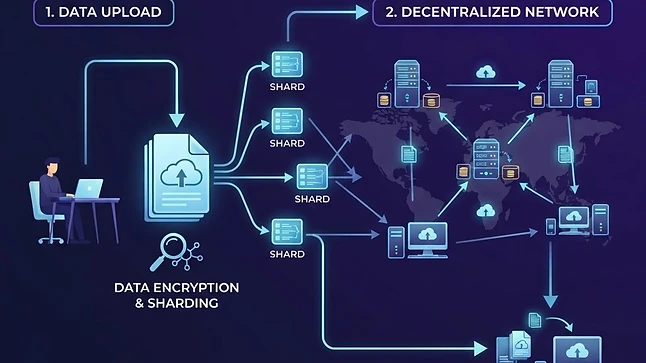
Decentralized storage spreads files across many computers instead of storing them in one central server. This can improve resilience, reduce single points of failure, and give users more control over how data is stored and accessed.
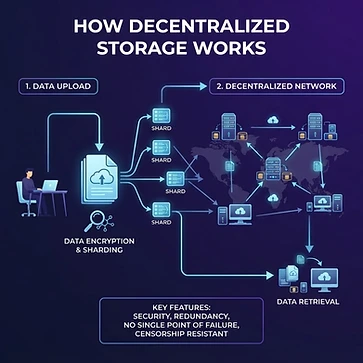
Most online files today are stored on centralized servers owned by large companies. If those servers fail, are censored, or become unavailable, access to the data can be disrupted. Decentralized storage offers another model by spreading data across many computers in a distributed network.
What decentralized storage is
In a decentralized storage system, files are typically:
- Split into smaller pieces or chunks
- Distributed across multiple nodes
- Verified using cryptography
- Retrieved through a network rather than one provider
This reduces reliance on a single company or data center.
How it works in practice
Although designs vary, a common process looks like this:
- A user uploads a file
- The file may be encrypted for privacy
- The system breaks it into pieces
- Pieces are stored across many network participants
- A content identifier or reference is created
- The file can later be retrieved and reassembled
Some systems also reward storage providers with tokens for offering disk space and reliable uptime.
Why people use it
Decentralized storage can offer several benefits:
- Resilience: no single point of failure
- Censorship resistance: harder for one party to remove data everywhere
- User control: less dependence on a single platform
- Redundancy: multiple copies may improve availability
This makes it useful for blockchain applications, NFT media, public archives, and distributed websites.
Important limitations
It is not a perfect solution for every use case.
Beginners should understand these trade-offs:
- Performance may vary compared with centralized cloud services
- Privacy depends on whether files are encrypted
- Persistence may require payment or active hosting incentives
- Ease of use is still improving
Also, decentralized storage does not automatically mean private storage. If data is public and unencrypted, others may still access it.
A simple analogy
Think of centralized storage like keeping all your important papers in one office building. Decentralized storage is more like making secure copies and placing them in many lockers across a city. If one locker becomes inaccessible, the file can still be recovered from others.
Key takeaway
Decentralized storage changes the way data is hosted by distributing responsibility across a network. For beginners, the core lesson is this: it is designed to make files more resilient and less dependent on a single provider.
As Web3 grows, decentralized storage is becoming an important complement to blockchains, which are not ideal for storing large files directly.
Comments (0)
Be the first to comment.