
Zero-Knowledge Proofs: A Beginner's Guide
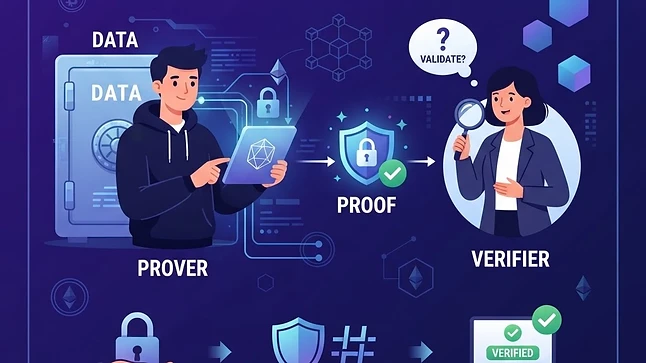
Zero-knowledge proofs let someone prove a statement is true without revealing the underlying information. In crypto, they are important because they can improve privacy and scalability while still allowing networks to verify transactions.
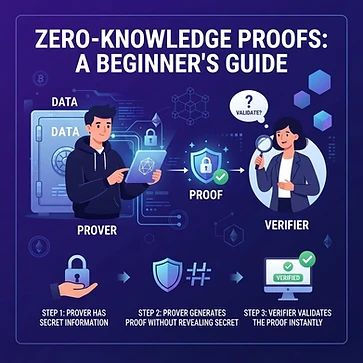
Zero-knowledge proofs, often shortened to ZK proofs, are a cryptographic method that lets one person prove something is true without revealing the actual secret behind it. That may sound magical, but the core idea is surprisingly practical.
The simple concept
Imagine you want to prove you know a password, but you do not want to tell anyone what the password is. A zero-knowledge proof allows you to demonstrate knowledge of the password without exposing it.
This means a verifier can learn:
- The claim is valid
- The prover likely has the secret information
- The secret itself remains hidden
Why this matters in blockchain
Public blockchains are transparent by design. That is useful for verification, but it can create privacy concerns. ZK proofs help solve this by allowing verification without full disclosure.
They are used for:
- Private transactions
- Identity verification without exposing personal details
- Scalability systems that bundle many transactions together
- Selective disclosure of data
A real-world style analogy
Suppose you want to prove you are over 18. Normally, you might show an ID card that reveals your full name, birthday, and address. With zero-knowledge technology, you could prove only the fact that matters: you are over 18.
That is the power of ZK systems: revealing less while proving enough.
Common terms beginners may see
You may come across these phrases:
- zk-SNARKs: compact proofs, popular in privacy and scaling systems
- zk-STARKs: another type of proof designed with different trade-offs
- Rollups: Layer 2 systems that often use ZK proofs to improve throughput
You do not need to master the math to understand the value.
Benefits of zero-knowledge proofs
- Privacy: less sensitive data is exposed
- Efficiency: many transactions can be verified more compactly
- Security: trust comes from cryptography, not just reputation
- Better user control: share only what is necessary
Challenges to know
ZK technology also has trade-offs:
- Can be complex to build
- May require advanced engineering
- Some systems have heavy computation needs
- User experience is still improving
Key takeaway
Zero-knowledge proofs help answer an important digital question: How can I prove something without giving away everything?
For beginners, that is the main idea to remember. In blockchain, ZK proofs are a major tool for building systems that are both verifiable and more private.
Comments (0)
Be the first to comment.