
Proof of Work vs Proof of Stake Explained
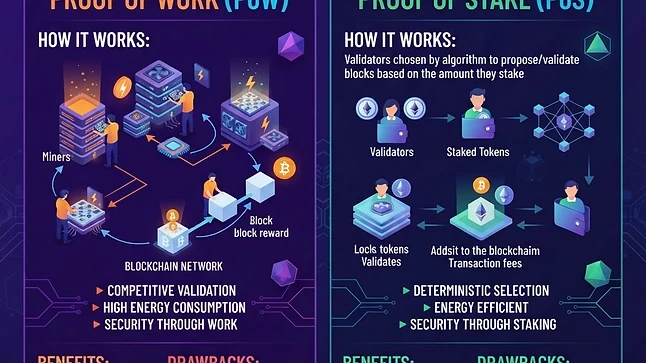
Proof of Work and Proof of Stake are two major ways blockchains reach agreement about which transactions are valid. Both help secure decentralized networks, but they do so with very different trade-offs in energy use, cost, and participation.
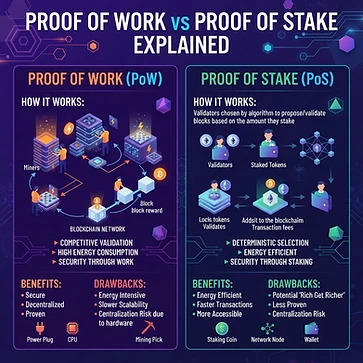
Blockchains need a way to agree on which transactions are valid and in what order they should be added. This process is called consensus. Two of the most common consensus methods are Proof of Work (PoW) and Proof of Stake (PoS).
Proof of Work in simple terms
In Proof of Work, computers called miners compete to solve difficult mathematical puzzles. The first to solve the puzzle earns the right to add the next block and usually receives a reward.
Key features of PoW:
- Requires specialized hardware in many cases
- Uses significant electricity
- Makes attacks expensive because they require real-world resources
- Has been used by networks like Bitcoin
The idea is that because mining costs money, dishonest behavior becomes harder and less attractive.
Proof of Stake in simple terms
In Proof of Stake, participants called validators lock up some of their cryptocurrency as a stake. The network then chooses validators to confirm transactions and create new blocks.
Key features of PoS:
- Uses far less energy than PoW
- Does not require puzzle-solving competition
- Rewards users for staking coins
- Can lower hardware barriers to participation
If a validator acts dishonestly, part of their stake may be taken away. This penalty helps keep the network secure.
Main differences
Here is the beginner-friendly comparison:
- Energy use
- PoW: high
- PoS: low
- Security cost
- PoW: based on electricity and hardware
- PoS: based on locked capital
- Participants
- PoW: miners
- PoS: validators
- Equipment needs
- PoW: often expensive hardware
- PoS: coins to stake
Which is better?
There is no universal winner. It depends on what a network values most.
PoW is often praised for:
- Simplicity of security model
- Strong history of real-world operation
- Deep resistance based on physical resource costs
PoS is often praised for:
- Better energy efficiency
- Faster scalability options
- Easier participation for more users
A quick analogy
Think of PoW like a race where participants burn fuel to win. Think of PoS like a lottery where participants deposit money as collateral to earn the right to verify.
What beginners should remember
Both systems try to answer the same question: who gets to update the blockchain fairly and securely?
PoW uses computational work. PoS uses economic stake. Understanding that difference helps explain why blockchains vary in speed, cost, and environmental impact.
Comments (0)
Be the first to comment.