
Understanding Market Cap vs Trading Volume

Market cap and trading volume are two of the most common crypto metrics, but they measure very different things. This post explains what each one means, how to use them together, and where beginners often get confused.
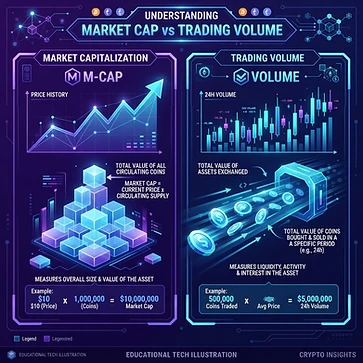
Why these two metrics matter
When you look at a crypto asset, two numbers usually stand out: market cap and trading volume. They sound similar, but they answer different questions.
- Market cap tells you how large the asset is
- Trading volume tells you how active the market is
Understanding both can help you avoid common beginner mistakes.
What market cap means
Market cap is calculated like this:
- market cap = current price x circulating supply
If a coin trades at $10 and has 100 million coins in circulation, its market cap is $1 billion.
This metric is useful because it gives a rough sense of the project's size relative to others.
In general:
- large-cap coins are often more established
- mid-cap coins may offer more growth but more risk
- small-cap coins can be highly volatile and less liquid
What trading volume means
Trading volume measures how much of an asset was bought and sold over a set period, usually 24 hours.
High volume can suggest:
- strong market interest
- better liquidity
- easier entry and exit for traders
Low volume can suggest:
- less attention
- wider bid-ask spreads
- a greater chance of sharp price moves
Why beginners mix them up
A coin can have a large market cap but low trading volume. That means it is valuable on paper, but not necessarily very active right now.
A coin can also have high trading volume but a smaller market cap. That may happen when short-term speculation is intense.
This is why looking at only one metric can be misleading.
How to use them together
A practical way to evaluate a crypto asset is to ask:
- Is the market cap realistic for the project's adoption?
- Is trading volume strong enough to support healthy liquidity?
- Did volume spike because of real news or just hype?
- Is volume spread across reputable exchanges?
Common mistakes to avoid
- assuming a low-priced coin is cheap without checking supply
- treating high volume as proof of quality
- ignoring liquidity when buying smaller tokens
- comparing coins only by price instead of market cap
The beginner takeaway
Market cap helps you understand size. Trading volume helps you understand activity.
Used together, they give a much clearer picture of a cryptocurrency than price alone. If you want to make smarter decisions, always check both before buying, selling, or comparing projects.
Comments (0)
Be the first to comment.